skip to main |
skip to sidebar
 With a population of over three million people is Yokohama Japan's second largest city. Yokohama is located less than half an hour south of Tokyo by train, and is the capital of Kanagawa Prefecture.Towards the end of the Edo Period (1603-1867), during which Japan maintained a policy of self-isolation, Yokohama's port was one of the first to be opened to foreign trade in 1859. Consequently, Yokohama quickly grew from a small fishing village into one of Japan's major cities.Until today, Yokohama remains popular among expats, has one of the world's largest chinatowns and preserves some former Western residences in the Yamate district.
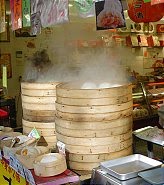
 Yokohama Chinatown (横浜中華街) is Japan's largest chinatown, located in central Yokohama.Yokohama Chinatown quickly developed, after the port of Yokohama had been one of the first Japanese ports to be opened to foreign trade in 1859. It became the residence of the many Chinese traders who settled down in the city.Today, a large number of Chinese stores and restaurants can be found in the narrow and colorful streets of Chinatown, while the number of actual residents has been decreasing.Four colorful gates stand at the entrances to Chinatown, and five more gates can be found within. The Kanteibyo is a gaudily colored temple in the center of Chinatown. Constructed in 1873 by Chinese residents, it is dedicated to the Chinese god of good business and prosperity.The main attraction of the Yokohama Chinatown, however, is the cuisine offered at its many restaurants and food stands. Popular favorites include steamed buns (manju), ramen noodles and a wide array of other Chinese dishes, many of which have been Japanized to a certain degree.Various events and festivals are held in Yokohama Chinatown, such as Chinese New Year around the beginning of February.


Minato Mirai 21 is a seaside urban area in central Yokohama whose name means "harbor of the future". It has many large high-rises, including Japan's tallest building, the Landmark Tower. Until the 1980s the area was a large shipyard, but the shipyard moved and development began for a new city center.
Minato Mirai is blessed with a great location along the water and has a wealth of attractions. Visitors to the area will be able to find shopping centers, hotels, a convention center, an amusement park, a relaxation center with hot spring baths, museums and park space.


Located along the waterfront, the buildings of the Minato Mirai Chuo district ("central district") form the distinctive skyline of Yokohama. At 296 meters, the Landmark Tower is the most recognizable feature. The three Queen's Towers are located beside, each one being a little shorter than the next, followed by the Pan Pacific Hotel and the Pacifico convention center, one of the largest in Japan, which includes the rounded Intercontinental Hotel. The district extends inland, where redevelopment is still ongoing.
Connected to the Chuo district, across from the Pacifico, is a large man made island which constitutes the Minato Mirai Shinko District ("new harbor district"). The most recognizable feature of the island is the Cosmo World Ferris Wheel, which displays the time and was for a period the world's largest clock.
MuseumsThere are several museums in the Minato Mirai district, including the municipal art gallery and museums on the port of Yokohama, shipping, industry and technology. Nippon Maru and Yokohama Port MuseumBuilt in 1930, Nippon Maru is a retired sailing ship that is permanently docked at Minato Mirai and is open to the public. Across from the ship is the Yokohama Port Museum, a recently remodeled museum that has a History Zone illustrating the port's entire history and a Rediscovery Zone which illustrates broader marine topics.
 Yokohama Museum of ArtThe Museum has seven galleries; three for displaying works from the permanent collection, one for photography, and three for special exhibitions (four per year). The museum focuses on contemporary art as well as Yokohama itself, the city, its role as a port, and its artists.
 Mitsubishi Minatomirai Industrial MuseumThe museum has six zones: space, ocean, transportation, daily life discovery, environment and technology quest. The present and future of each zone's theme is presented, with many interactive elements like computer simulators. The museum seems generally geared towards kids.
ShoppingMinato Mirai offers a wide range of shopping opportunities to visitors. The Landmark Plaza and Queen's Towers have many floors filled with the typical sorts of shops and restaurants that one would expect to find at shopping malls. On the man made island in the Shinko district, shoppers will find a more unique selection of goods at the World Porters Mall and Red Brick Warehouses. Queen's SquareQueen's Square is located in the lower floors of the three Queen's Towers. They offer a variety of shops and restaurants, including various well known brand stores. The Minato Mirai Station is located in the basement.
 Landmark PlazaThe Landmark Plaza is located just beside Queen's Square and is located adjacent to the Landmark Tower. The five floors of the Landmark Plaza feature a similar variety of shops and restaurants to those found in the Queen's Towers, including a Pokemon Center on the 4th floor.
 World PortersThe World Porters Mall has six floors, with each one dedicated to a certain theme. From the ground floor up, they are food, fashion, sports and hobby, home and living, broadway (cinema), relaxation and interiors. The broadway floor has a movie theater and amusement center. The food floor includes an extensive supermarket.
 Red Brick WarehousesThe Red Brick Warehouses (akarenga soko in Japanese) used to serve the area when it was a port, but have since been converted. They now offer a unique atmosphere for shopping. The two buildings have a number of shops that offer interesting products, as well as some restaurants and floorspace dedicated to events and exhibitions.